Vapor barrier installation in Roswell NM - a crawl space liner with every seam sealed
Bare dirt or torn plastic under your house? We put down a liner that covers the ground, with the seams sealed shut.
Does my crawl space need a vapor barrier?
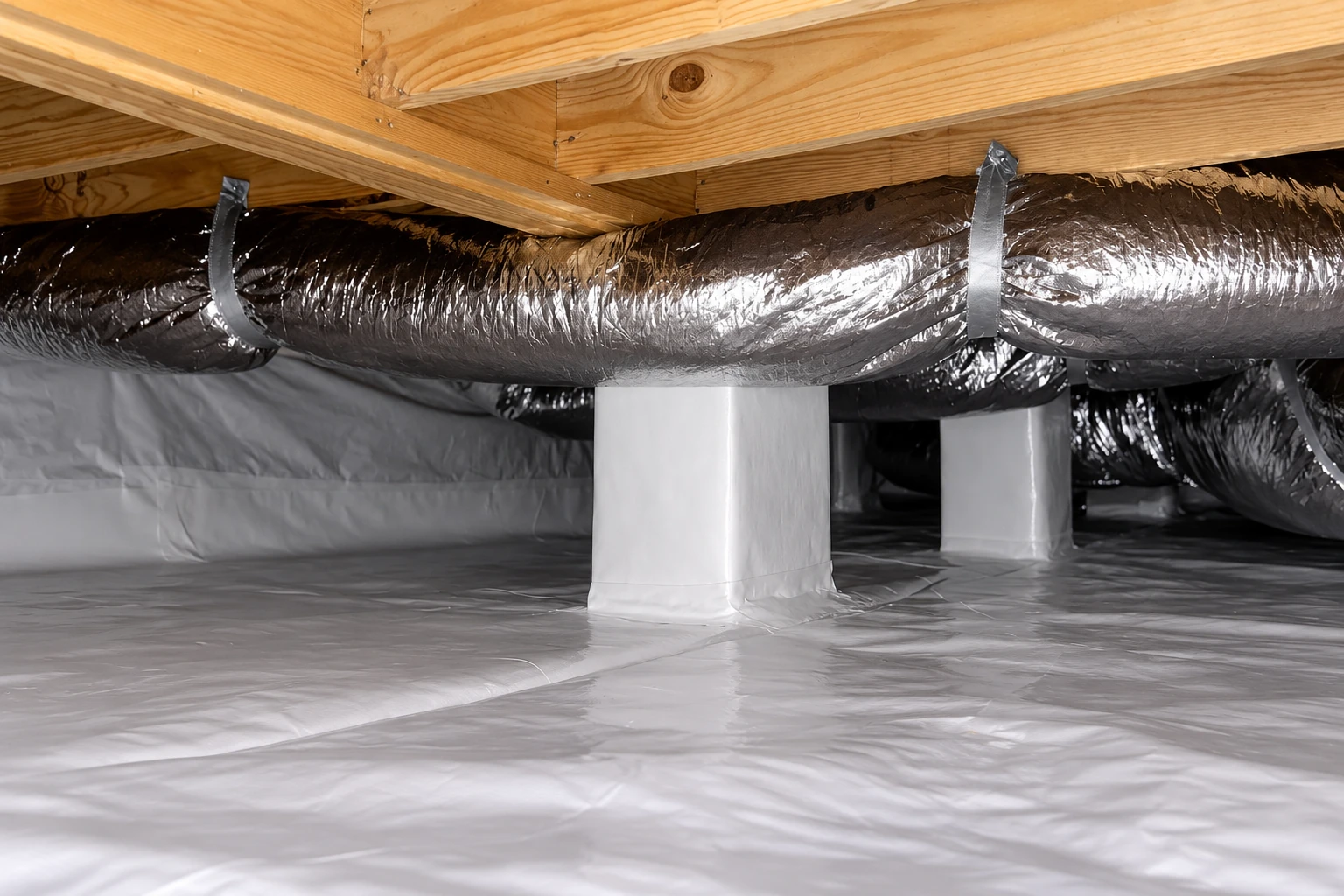
Vapor barrier installation in Roswell means laying a liner over the bare dirt in your crawl space so moisture from the ground can't rise into the space under your floors, where it would settle on the wood and pipes.
Most folks call because there's bare dirt under the house, or an old sheet of plastic that's torn, bunched up or full of gaps, and maybe a musty smell coming up through the floor. The price mostly follows the size of your crawl space, how much room there is to work down there and which liner you pick. The schedule turns on how easy it is to get under the house, how much old material has to come out first and whether the city wants a permit. The state energy code puts Roswell in climate zone 3B, and a lot of the ground here is the Roswell soil series, deep sand that wind has reworked and that lets water pass through quickly. That's background, not a verdict on your house. One building science firm says that in a dry climate, a crawl space that isn't treated as part of the house is kept closed off from it, so whether yours should be closed off or brought inside is something I sort out once I've been under there. New Mexico's Construction Industries Division requires a license for anyone offering construction contracting, and we're licensed and fully insured. When I come out, you get photos of what's under your house and a written estimate with your own figure on it.
What happens after you call about a vapor barrier?
Call or send the form
You can reach me at (575) 363-2021, since I still answer the phone myself, or send the contact form. We'll set up a time for me to come out to your house.
I look under your house
I go into the crawl space myself, take photos and show you what I found, so you know what the dirt, the old plastic and the piers look like before we talk about fixing anything. Then you get a written estimate with the price laid out, and you decide from there.
Our crew installs the liner
Once you say yes, our installers do the work. They treat your home like somebody lives there, because somebody does.
We walk the finished job
Before we pack up, I go over the finished crawl space with you. You can see the coverage and the sealed seams without crawling under there yourself.
How we install a vapor barrier, and the work that goes with it
We start by clearing out what doesn't belong, like torn plastic and junk that's been sitting in the dirt, because a new liner laid over a mess just hides the problem. Then we help you pick a liner that fits how often you go under the house and how long you plan to live there, since a space you store things in or crawl through to reach equipment takes more wear than one nobody visits. We roll it out over the ground and cut it to fit around the piers and pipes. Then we seal the seams shut instead of just laying one sheet over the next, because an overlap is a gap that moisture can find. We clean up on the way out.
A liner handles moisture from the ground, but if the house still feels drafty or the power bill runs high, the leak is usually somewhere else. Attic air sealing closes the gaps around lights, pipes and the attic hatch so your heated and cooled air stays inside. Retrofit insulation adds insulation to an older house's walls or attic without tearing the place apart. If I see a reason for either while I'm there, I'll tell you, and if I don't, I'll say that too.
Get a vapor barrier estimate for your crawl space
Send the form and I'll get back to you within one business day to set up a time to come look under your house. The estimate is free and done on site, and there's no obligation to go ahead.
Crawl space vapor barrier questions from Roswell
What does a vapor barrier in a crawl space actually do?
It keeps moisture in the ground from evaporating up into your crawl space. One building science report says crawl spaces must always have a ground cover like this, so bare dirt is the first thing I look for when I go under a house.
What is the best way to cover a crawl space floor, plastic or a concrete slab?
One building science firm recommends a continuous sealed ground cover, either taped polyethylene sheeting or, as its preferred choice, a thin concrete slab poured over polyethylene with sealed joints. A slab gives you a hard floor, but it's a bigger job, so for most houses I'd go with a heavy liner sealed at every seam unless you're down there often to store things or work on equipment. We'll talk it through at the estimate.
How long does a crawl space vapor barrier last?
One cost guide puts a 6-mil contractor-grade plastic sheet at 3 to 5 years and a 20-mil reinforced barrier at 25 years or more. That's why how long you plan to stay matters, because the thin sheet is a short-term fix and the heavier barrier is the long-term plan. Whichever you pick, the job is backed by our satisfaction guarantee.
How much does vapor barrier installation cost in Roswell?
Your price comes from the estimate, because it depends on the size of your crawl space, how thick a liner you choose and how much work it takes to get the space ready. A low, tight crawl space is slower to work in, old plastic or junk has to come out first, and every pier and pipe is one more spot to cut and seal around, so each of those raises the cost. I'll lay the choices out so you can see what each one adds.
Do I need a permit to install a vapor barrier in Roswell, NM?
The city's Building Inspections office issues building permits for renovations, remodels, additions and building of any kind, so it's the office that decides whether your job needs one. We check with the right office about your job, go over what we learn at the estimate and take care of the permit when one is needed.
What should I ask a contractor before they install a crawl space vapor barrier?
Ask whether the liner will cover all of the ground and whether the seams get sealed, because one cost guide says a barrier works as long as it covers 100% of the ground surface and its seams are sealed, not just overlapped. The same guide suggests asking whether it will run up the walls and around the piers, the way it does in encapsulation, where the whole crawl space gets closed up, and whether every pipe or wire coming through gets sealed. Hold my bid to the same questions.
Other work that pairs with a vapor barrier
Attic air sealing
If rooms upstairs run hot or the house feels drafty after the crawl space is done, sealing gaps in the attic is usually the next place to look.
Retrofit insulation
Older homes often have thin or settled insulation in the walls and attic, and retrofit work adds more without opening up the whole house to do it.
Get your crawl space looked at
Call (575) 363-2021 or send the form, and have a rough idea of how often you go under the house and what you keep or fix down there, so we can talk liners on the first visit.